What is a crown?
A crown, often called a cap, covers the whole visible part of a tooth. It brings back the tooth’s shape and strength, and protects what is left of it.
You might need a crown when:
- a tooth has a very large filling and little natural tooth left
- a tooth is cracked or broken
- a back tooth has had root canal treatment and needs protecting
- teeth are badly worn down, for example from grinding
- a tooth is badly stained or misshapen
- it is going on top of a dental implant
What is a bridge?
A bridge replaces one or more missing teeth. A false tooth is joined to crowns on the teeth either side of the gap, and the whole piece is fixed in place. Unlike a denture, you do not take it out.
Which material?
| Material | What it is like |
|---|---|
| All-ceramic | Looks the most natural and has no metal. Zirconia, a very strong ceramic, also suits back teeth. |
| Porcelain on metal | Strong, with a long track record. A thin dark line can show at the gum over the years. |
| All-metal | Very strong and needs the least tooth trimmed, but is metal coloured, so it is kept for back teeth. |
Dr. Laura will suggest a material based on which tooth it is, how you bite, and your budget.
The steps
- First visit. The tooth is checked and X-rayed. Then, with the area numb, it is shaped to make room for the crown. A mould or scan is taken, the shade is matched to your other teeth, and a temporary crown is fitted.
- In the lab. A dental lab makes your crown, which usually takes a few days to two weeks.
- Second visit. The temporary crown comes off, and the new crown is checked for fit, bite and colour before it is fixed in place.
A bridge follows the same steps, with the teeth on both sides of the gap prepared.
Weak toothLarge old filling and a crack
ShapedDashed line: the old outline
Crown fittedFull shape and strength back
Bridge or implant?
To fill a gap, a bridge is quicker and needs no surgery, but the healthy teeth either side are trimmed down to hold it. An implant leaves the neighbouring teeth alone and helps keep the jawbone, but takes a few months to heal. Dr. Laura will talk you through both.
Caring for crowns and bridges
- Brush twice a day and clean between your teeth, paying attention to where the crown meets the gum.
- Under a bridge, clean beneath the false tooth every day with a floss threader or a small interdental brush.
- Avoid biting hard objects such as ice, bottle tops or your nails.
- If you grind your teeth at night, ask about a night guard to protect your crowns.
While you have a temporary crown, avoid sticky food, chew on the other side, and if it comes off, keep it and call the clinic.
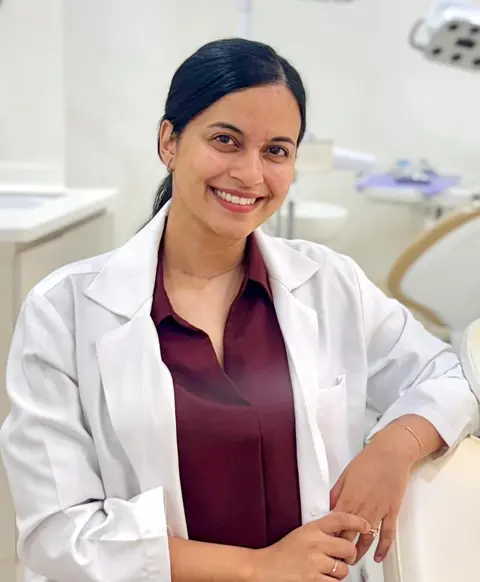
Your dentist
Dr. Laura Albuquerque
Dr. Laura’s MDS is in Prosthodontics and Crown & Bridge, so crowns and bridges are at the centre of her training. She plans each one around your bite and your other teeth, not just the tooth being treated.
Common questions
Does getting a crown hurt?
The tooth is numbed before it is shaped. It may feel a little sensitive for a few days afterwards.
How long does a crown last?
With good care, many years, often ten or more. Grinding, biting hard objects and poor cleaning at the gum line shorten its life.
Can a tooth with a crown still get decay?
The crown itself cannot decay, but the tooth underneath can, at the edge where the crown meets the gum. Brushing and cleaning between teeth there keeps it healthy.
Will my crown look natural?
Ceramic crowns are matched to the shade and shape of your own teeth, so on a front tooth they are hard to tell apart.
How much does a dental cap cost?
It depends mostly on the material. All-metal caps cost the least, porcelain-on-metal sits in the middle, and all-ceramic or zirconia caps cost the most. A bridge costs more than a single cap because it covers more than one tooth. Dr. Laura will tell you the cost of each option before you choose.
How many visits does a crown take?
Usually two: one to prepare the tooth and fit a temporary crown, and one to fit the final crown once the lab has made it.
This page gives general information, not advice for your own teeth. Dr. Laura will explain what suits you, and what it will cost, after examining you.