What happens at a check-up
A check-up is a careful look at your whole mouth, not just your teeth. It usually takes a short visit.
- Your health. Dr. Laura asks about any illness and medicines, because things like diabetes, blood thinners and some heart conditions change how dental care is planned.
- Teeth. Each tooth is checked for decay, cracks, wear and old fillings or crowns that need attention.
- Gums. The gums are checked for bleeding, swelling and pockets, the early signs of gum disease.
- The rest of the mouth. Tongue, cheeks and palate are checked for sores or patches that should be looked at.
- X-rays, if needed. They show decay between teeth and problems under the gum that cannot be seen by eye.
Professional cleaning (scaling and polishing)
Plaque is the soft, sticky film that builds up on teeth every day. If it is not brushed away, it hardens within days into tartar, also called calculus. Tartar cannot be removed with a toothbrush, and it gives germs a rough surface to cling to, both above the gum and just under it.
Cleaning removes it in two parts:
- Scaling. Tartar is lifted off with an ultrasonic scaler, which uses fine vibration and a stream of water, and with small hand instruments for the last traces, including just under the gum line.
- Polishing. The teeth are polished smooth, which removes surface stains and makes it harder for plaque to stick.
Before
After
If tartar has built up deep under the gums, a deeper clean may be needed, sometimes over more than one visit.
Bleeding gums
Gums that bleed when you brush are usually a sign of gingivitis: inflammation caused by plaque and tartar at the gum line. It is common and it reverses with cleaning and good brushing. Left alone, it can turn into periodontitis, where the bone around the teeth is slowly lost and teeth can loosen. Do not stop brushing bleeding gums; brush gently and book a clean.
How often should you come?
Most people do well with a check-up and clean about every six months. Some need it more often, for example if they build up tartar quickly, have gum disease, smoke, or have diabetes. Dr. Laura will suggest the right gap for you.
Keeping your teeth clean between visits
- Brush twice a day for two minutes with a fluoride toothpaste, angling the brush toward the gum line.
- Clean between your teeth once a day with floss or small interdental brushes.
- Keep sugary snacks and drinks to mealtimes rather than through the day.
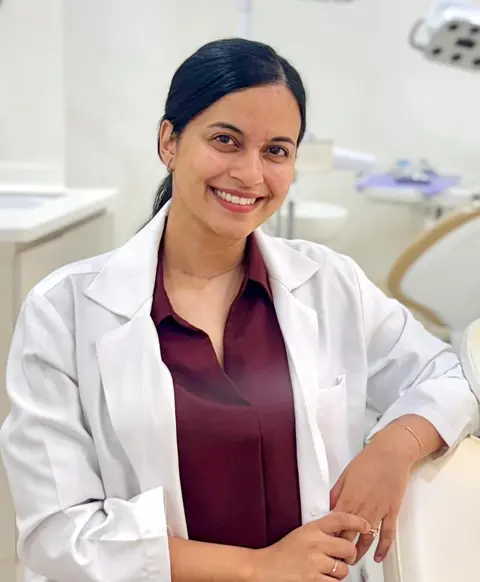
Your dentist
Dr. Laura Albuquerque
Dr. Laura sees patients for routine check-ups and cleaning as well as specialist work, so the same dentist who knows your mouth looks after both.
Common questions
Does a dental cleaning hurt?
Most people find it comfortable. You may feel some vibration, water and scraping, and teeth can feel sensitive for a day or two afterwards, especially if there was a lot of tartar. Tell Dr. Laura if your teeth or gums are sensitive.
How much does teeth cleaning cost in Goa?
It depends mainly on how much tartar there is and whether a deeper clean under the gums is needed. Dr. Laura will tell you what you need, and the cost, before she starts.
Will cleaning make my teeth whiter?
Polishing removes surface stains from tea, coffee and tobacco, so teeth often look brighter. It does not change the natural colour of the tooth; that is what teeth whitening is for.
Can cleaning loosen my teeth?
No. Sometimes teeth feel different once a large lump of tartar is removed, because it was covering gum that had already shrunk back. Cleaning stops that getting worse.
I am only in Goa for a short time. Can I have a check-up and clean?
Yes. A check-up and clean is usually done in one visit, so it fits easily into a short stay.
This page gives general information, not advice for your own teeth. Dr. Laura will explain what suits you, and what it will cost, after examining you.